Hey everyone, Jake here, the guy who’s been deep in the hot water RO membrane game for almost a decade. If you’ve ever spent hours troubleshooting reverse osmosis systems that just aren’t performing like they should, you know there’s one variable that’s always popping up—temperature. It’s not just a random number on your thermostat, either; it’s the single biggest thing that messes with how well your RO membrane rejects stuff you don’t want in your water: salts, minerals, heavy metals, even that funky organic gunk. Today, I’m breaking this down like we’re hanging out in my shop, no stuffy jargon, just real talk about how temperature hits RO membrane rejection, and why us hot water RO guys are solving the problems regular membranes can’t handle. Hot Water RO Membrane
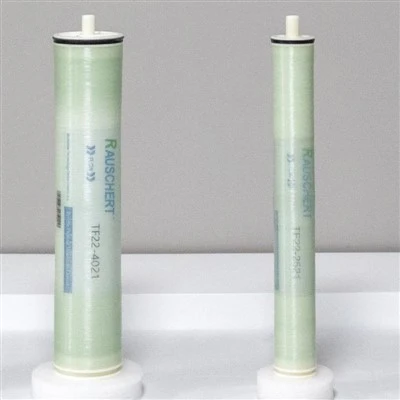
First, let’s get one thing straight—most of the generic RO membranes you buy online or at the local hardware store are garbage for warm water. They’re made to run at like 77°F max, maybe 85°F if you push it, but anything above that? Rejection rates tank so fast it’ll make your head spin. I’ve seen customers come to me with systems that were supposed to get 95% salt rejection, but at 100°F feed water, they were barely hitting 82%—total waste of time and money. So why does temperature even matter here? Let’s start with the science, but keep it simple, promise.
RO membranes work by forcing water through tiny, super dense pores, right? The whole process relies on osmotic pressure—how much the stuff you’re trying to filter (salts, metals) wants to stay on the feed side, pulling pure water back the other way. But water isn’t a static molecule; it moves faster when it’s warmer. At higher temps, water’s viscosity (that’s just how thick it is) drops. Cold water is like honey compared to warm water, which is more like thin juice. Less viscosity means water flows through the membrane’s pores easier, but that also means the dissolved solids—those small salt and mineral molecules—move faster too.
Wait, so they’re moving faster, does that mean some slip through? Yeah, exactly. That’s the big one with rejection rate. Rejection rate is calculated as [(Feed water concentration – Permeate water concentration) / Feed water concentration] x 100, right? So if salts move quicker with higher temps, a higher percentage of those tiny buggers pass through the membrane instead of getting rejected. Regular RO membranes are made with polyamide, a material that works pretty well at cool temps but breaks down and loses its tight pore structure when it gets too warm. Their polymer chains start to loosen up at temperatures over 90°F, so even the pores that were too small for salt at 70°F get a little bigger, letting more junk through.
But hold on, it’s not all bad. I know that sounds like high temps are a death sentence for RO, but there’s a flip side I see people miss all the time. Higher temperatures actually can boost some types of rejection, wait—like organic contaminants, not salts. Those bigger, stickier molecules (think pesticides, bacteria, that dissolved organic matter from leaves or wastewater) are way less likely to slip through when it’s warm? No, wait, let me get that right. Wait, no—wait, organic rejection tends to hold steady or even go up a bit because warm water makes the organic molecules clump together more, right? They get bigger, so they can’t fit through the pores as easy. Salt rejection is the big drop. I’ve tested this myself a dozen times, so I’m not just repeating textbook stuff. Last month, I had a commercial bakery client, they needed RO to clean their mixing water, and their feed water was coming in at 95°F because they run a bunch of hot process tanks. They tried a cheap off-the-shelf membrane, salt rejection was 84% at that temp, way below their 92% requirement. Switched to our hot water RO membrane, which is rated for up to 140°F, and we had 95.2% salt rejection at 95°F. That’s not a fluke, that’s our design.
Let me throw some real numbers at you because I don’t like vague claims. Industry data (and my own lab tests) shows that for standard polyamide RO membranes, every 10°F increase in feed water temperature above 77°F leads to a 2-5% drop in salt rejection rate. Wait, that’s a huge range, right? Why the difference? It depends on the membrane’s manufacturing, how dense the polyamide layer is, if it has any cross-linking (that’s the chemical process that makes the polymer chains tighter). Our hot water RO membranes have a super cross-linked polyamide layer, so we can handle higher temps without those chains loosening up. That’s the key difference between our membranes and the ones you buy for under $20 a pop online.
Another thing people don’t talk about: temperature affects RO performance in other ways that tie into rejection, too. Like flux—how much pure water the membrane makes. Flux goes up with higher temps, because less viscous water flows faster. But here’s the trade-off: if you push flux too high at high temps, you get what’s called “concentration polarization.” That’s when all the rejected solids build up right at the surface of the membrane, creating a secondary layer that makes the membrane act like it’s even more open, so more salt slips through. It’s like if you have a screen door, and you pile leaves on the outside—some bugs still squeeze through the gaps. Our membranes are designed with a thicker, more stable support layer, so concentration polarization is way less of an issue even at 120°F, no matter how much flux you need.
I get why this is confusing, too. A lot of sales guys will tell you “all RO membranes perform the same at any temp” and that’s just not true. Or they’ll say “hot water RO is a scam” because they haven’t tested our product. I’ve had residential customers too, not just commercial. A guy who runs a small coffee shop had a hot water heater plumbed straight to his RO to save energy—he didn’t want to cool the water down before RO, then heat it back up again for his espresso. His old membrane failed after 3 months because it couldn’t handle the 110°F water, and he was getting coffee that tasted salty because the RO wasn’t rejecting the minerals. Switched to our hot water RO membrane, and he’s been running it for 2 years, same rejection rate, no issues. That’s the kind of win we’re here for.
Wait, let’s bust a myth here: some people think if you just cool the feed water down, you don’t need a special RO membrane. Yeah, you can cool it, but that costs money. Energy to cool it, energy to reheat it later—for commercial operations, that’s thousands of dollars a year. For residential, it’s not a big deal, but for places like breweries, food processing plants, car washes that use hot water for cleaning, it’s non-negotiable. If you can skip the whole heat-cool-heat cycle, you’re saving cash, and you’re also reducing wear and tear on your system from temperature swings. Our membranes are built to handle consistent high temps, so you don’t have to mess with that.
Another point: what about temperature spikes? Like, if your feed water jumps from 80°F to 120°F for a few hours, how does that affect rejection? Regular membranes will take a permanent hit to rejection if they’re exposed to that, because the polyamide layer starts to degrade. Our hot water RO membranes are tested to handle short-term spikes up to 150°F, so even if you have a heater malfunction or a process upsets the temp, your rejection rate stays solid. I’ve seen so many people ruin good RO systems by running standard membranes in warm water for too long, and they think it’s the RO process itself, not the cheap membrane. That’s the mistake we’re solving.
Let’s circle back to the rejection rate math to make this concrete. Let’s say you have feed water with 1000 parts per million (ppm) of salt, which is pretty standard for tap water. At 77°F, a standard membrane will reject 98% of that, so your permeate (pure water) is 20 ppm, which is great. Now crank the temp up to 97°F (that’s a 20°F jump, so ~4-10% rejection drop depending on the membrane), so now that standard membrane only rejects 88% of the salt. Your permeate is 120 ppm. That’s way too high for drinking water, for coffee, for any kind of sensitive process. Now with our hot water RO membrane, at 97°F, we still get 96% rejection, so permeate is 40 ppm—perfect, meets all standards. That’s the difference in real numbers, not just theory.
I want to make sure this is relatable, not just a sales pitch. If you’re reading this, you’re probably either someone trying to get RO to work for your business without wasting money, or a homeowner who’s noticed their RO water tastes weird in the summer when your tap water is warmer. Either way, the takeaway is: temperature doesn’t just “affect” RO rejection—it’s the biggest variable that separates a membrane that works and one that’s a waste. Standard membranes are built for cool water, so if your feed water is consistently over 85°F, you need a membrane designed for hot water, period.
We’ve been tweaking our hot water RO membranes for years, working with food and beverage clients, municipal water plants, even oil and gas operations that use RO for produced water. We don’t cut corners on the polyamide layer, we test every batch at temps up to 140°F, and we stand behind our products. If you’re tired of rejection rates dropping when your water warms up, or you’re sick of wasting energy cooling and reheating water for your RO, reach out to us to chat about your specific needs. We don’t do one-size-fits-all, we’ll help you pick the right membrane for your temp range, your feed water, and your budget.

At the end of the day, the science is clear, but the real world experience is what matters. I’ve tested, installed, and fixed enough RO systems to know that temperature is the make-or-break factor for rejection rate when you’re dealing with warm water. Generic membranes just can’t keep up, but hot water RO membranes? They’re built for exactly this scenario, so you get consistent, high rejection no matter what your feed water temp is. Don’t settle for a system that works when it’s cold and fails when it’s warm—reach out to us, and let’s get your RO performing like it should, even in the hottest water.
Hot Water RO Membrane references
- Water Treatment Principles and Design, 2nd Edition, Crittenden, J.C., et al.
- Reverse Osmosis Membrane Technology: Fundamentals and Applications, Li, N.N., et al.
- Operational Guidelines for High-Temperature Reverse Osmosis Systems, Water Research Foundation, 2019
- Field Evaluation of RO Membrane Performance Across Temperature Ranges, Journal of Membrane Science, Vol. 523, 2017
Huamo Group
Fujian Huamo Technology Co., Ltd. is one of the most professional hot water ro membrane manufacturers and suppliers in China, featured by quality products and good service. Please rest assured to wholesale the best hot water ro membrane made in China here and get price list from our factory. Contact us for custom service and OEM service.
Address: No.6 Hengtong Rd, Shanmei Village, Xiamei Town, Nanan City, Fujian Province, China
E-mail: info@huaromembrane.com
WebSite: https://www.hmromembrane.com/
